







Dengue risk in Kerala: How climate signals could support earlier warnings
Dengue searches in India tend to rise ahead of and during the monsoon season, according to a five-year Google Trends analysis. A recent study focused on Kerala has examined whether climate...


Dengue searches in India tend to rise ahead of and during the monsoon season, according to a five-year Google Trends analysis. A recent study focused on Kerala has examined whether climate information could help public health teams prepare for periods of higher dengue risk.
The study, published in GeoHealth, analysed 14 years of dengue and climate data from Kerala, covering 2006 to 2019. It examined factors such as temperature, rainfall, humidity, monsoon patterns and the El Niño–Southern Oscillation, a climate pattern linked to changes in Pacific Ocean temperatures.
What the researchers found
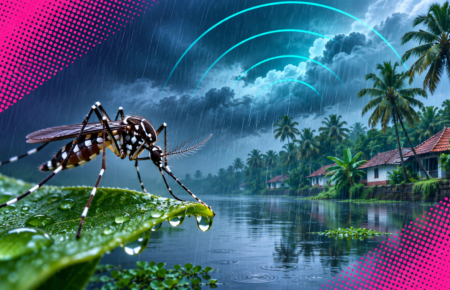
The researchers reported that dengue cases in Kerala often rise during the summer monsoon, with the study identifying June as a peak month in its historical dataset. Temperature, rainfall and humidity were among the factors associated with dengue incidence. Some climate signals were linked to case patterns several months later, which could give health authorities time to prepare.
The researchers also used climate model projections to examine possible future changes. These projections suggested that dengue incidence could rise under some future climate scenarios. They are model estimates, not a guarantee that cases will increase by a fixed amount in a particular year.
What an early warning could do
A climate-informed warning system could help local health teams plan mosquito control, public information and healthcare readiness before case numbers rise. Such a model would support planning, but it would not replace case monitoring or local public health decisions.
Weather is only one part of dengue risk. Mosquito breeding sites, housing, water storage, local sanitation and community prevention also matter. Conditions can differ between districts, so state-level estimates should not be treated as a forecast for every neighbourhood.
Practical steps for households
Residents can help reduce mosquito breeding by removing standing water from containers, trays and unused items around homes. Water storage containers should be covered, and local health guidance should be followed. Anyone with fever or other concerning symptoms should contact a healthcare professional, especially if their condition worsens.
The study offers a planning signal for health authorities, not a personal risk calculator. Its findings are specific to Kerala and rely on historical data and modelling. Continued surveillance and local evidence will be needed to assess how useful climate signals are in practice.
Source: GeoHealth research on climate-informed dengue prediction in Kerala; Google Trends analysis of seasonal dengue search interest in India.

No Comment! Be the first one.