








India’s Sickle Cell Programme Moves From Mass Screening to Long-Term Care
India has screened more than 7.1 crore people for sickle cell disease, making the programme one of the country’s largest population-level efforts to identify the inherited blood disorder....

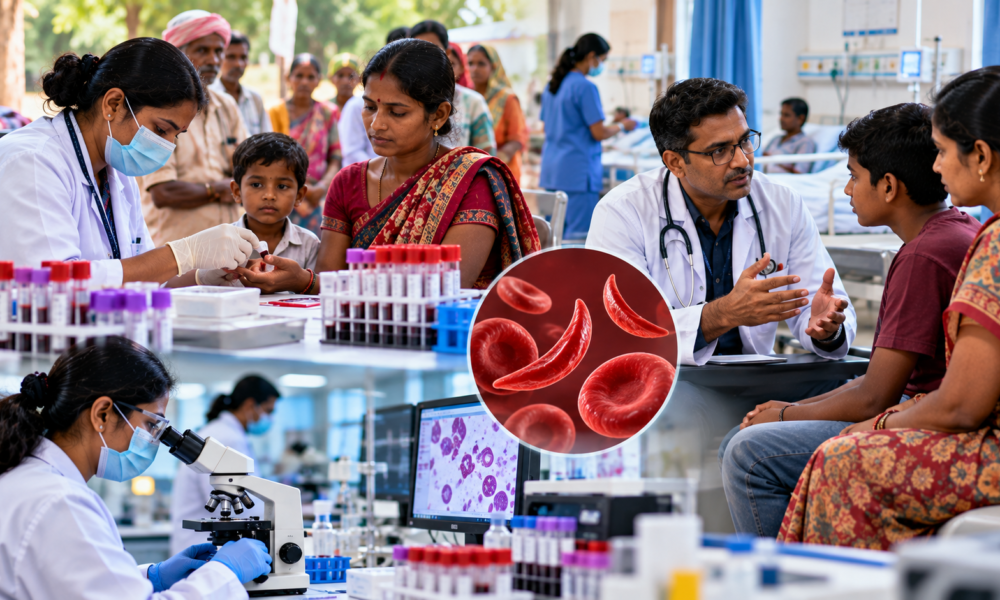
India has screened more than 7.1 crore people for sickle cell disease, making the programme one of the country’s largest population-level efforts to identify the inherited blood disorder. Government health data currently lists about 7.1 crore beneficiaries screened under the national sickle-cell programme.
The scale of screening is significant because sickle cell disease requires care that continues long after a person receives a diagnosis. A recent national discussion on sickle-cell care highlighted that identifying patients and carriers is only the beginning. Experts pointed to challenges involving treatment continuity, follow-up, medicine availability and access to specialist care.
Sickle cell disease affects haemoglobin, the protein in red blood cells responsible for carrying oxygen. People with the disease can experience anaemia, episodes of severe pain, infections and complications affecting different organs. The condition is inherited, which means identifying carriers can also be important for families and communities.
India’s screening campaign has therefore created a large new health-data layer. According to recent reports, more than seven crore people have been screened, with around 2.5 lakh patients identified and approximately 20 lakh carriers reported.
The challenge now is connecting those numbers to sustained healthcare.
Patients may require regular clinical monitoring, medicines such as hydroxyurea where medically appropriate, management of pain episodes and access to specialist services. Some patients with severe disease may also be assessed for haematopoietic stem-cell transplantation.
Experts participating in a recent national roundtable highlighted practical barriers including difficulty communicating test results to families, limited patient tracking, medicine shortages and long distances for medicine refills. Proposed solutions included unique patient identifiers, SMS reminders, village-level medicine depots and greater involvement of frontline health workers.
This makes sickle-cell disease a healthcare-infrastructure issue as much as a screening issue.
A screening programme can identify people at risk, but the health system must then retain them within a continuum of care. That requires primary-health centres, laboratories, specialist hospitals, medicines, patient records and referral networks to work together.
Digital health could become particularly useful in this process. India’s expanding digital-health ecosystem provides opportunities to connect patient records and follow-up information across different levels of care.
The government has also set a national goal of eliminating sickle cell disease as a public-health problem by 2047. Achieving that goal will depend not only on finding more patients but on ensuring that people who test positive remain connected to treatment and monitoring.
The next phase of India’s sickle-cell programme is therefore likely to be measured less by how many people are screened and more by what happens after screening.






No Comment! Be the first one.