








India Pushes for Responsible AI Adoption in Medical Technology
India is looking to accelerate the use of artificial intelligence in healthcare, with the Union Health Ministry highlighting medical technology as one of the country’s biggest opportunities for...

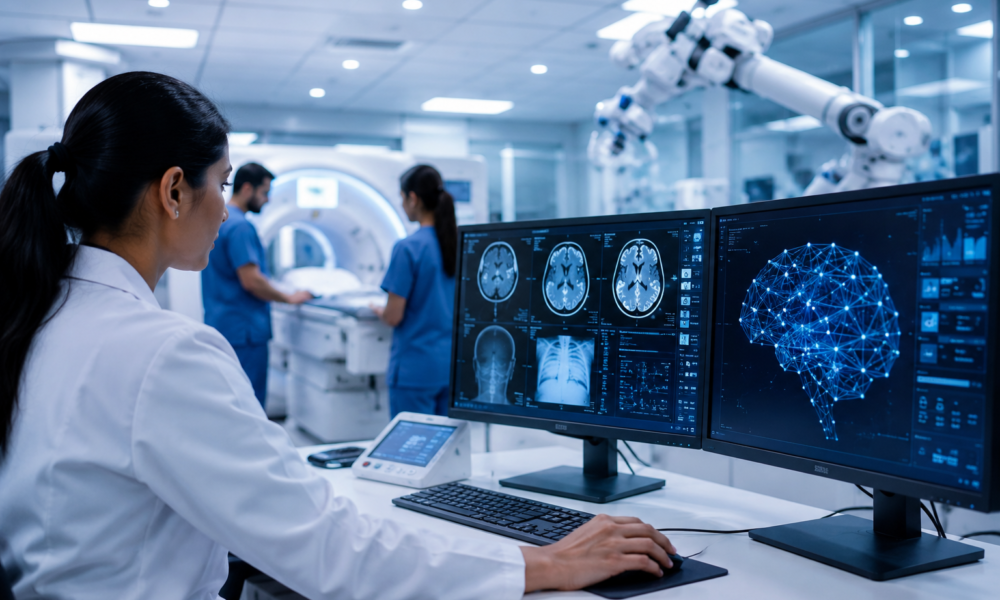
India is looking to accelerate the use of artificial intelligence in healthcare, with the Union Health Ministry highlighting medical technology as one of the country’s biggest opportunities for practical AI adoption.
Union Minister for Health and Family Welfare J P Nadda released a new knowledge paper titled “AI in MedTech: Revolutionising Healthcare Through Artificial Intelligence” at India Medical Device 2026 in New Delhi. The paper was jointly developed by Praxis Global Alliance and the Federation of Indian Chambers of Commerce and Industry (FICCI). It examines how AI is being used in diagnostics, clinical decision support, hospital operations and medical device innovation.
The report comes as India tries to move healthcare AI beyond demonstrations and small-scale pilot projects. According to the paper, the country already has several building blocks for digital healthcare, including the Ayushman Bharat Digital Mission, IndiaAI Mission, SAHI, BODH and the National Medical Devices Policy, 2023.
However, the report says moving an AI solution from a successful pilot to routine clinical use remains difficult. Fragmented health data, limited clinical evidence, evolving regulation and a lack of clear reimbursement pathways are among the major barriers identified in the paper.
This matters because healthcare AI cannot be treated like an ordinary consumer technology. An AI system used to support a diagnosis or medical decision has to work safely across different patients, hospitals and clinical settings. Doctors and healthcare providers also need evidence that these systems are reliable before they can become part of everyday care.
The report has identified five priorities for accelerating AI-enabled MedTech adoption in India. These include improving AI-ready data and evidence, creating lifecycle-based regulation for adaptive AI systems, and developing procurement and reimbursement systems that recognise the value of AI-enabled technologies.
Diagnostics are expected to become one of the first areas where AI could achieve large-scale adoption. The report says AI-enabled diagnostic tools could help extend specialist expertise into primary and secondary healthcare settings. This could be particularly important in areas where specialist doctors and advanced diagnostic services are not easily available.
The opportunity is also linked to India’s wider medical device industry. Government data shows that India’s medical device exports crossed US$4 billion in FY25, while policymakers have set a broader goal of developing the country into a global MedTech manufacturing hub. The government has also discussed a target of building a US$30 billion medical devices market by 2030.
For patients, the long-term benefit could be faster diagnosis, better access to specialist support and more efficient healthcare services. But the success of AI in medicine will depend on how safely and fairly these tools are introduced.
The report also stresses that no single organisation can build this ecosystem alone. Government agencies, regulators, hospitals, insurers, technology companies, manufacturers and academic institutions will need to work together.
India therefore faces a clear choice. It can continue developing impressive AI healthcare pilots, or build the data, regulation, evidence and payment systems needed to make these technologies part of everyday medical care.
The latest policy push suggests the focus is now shifting towards the second challenge: taking AI from the demonstration stage to the hospital floor.







No Comment! Be the first one.