








India May Introduce Stricter Red Warning Labels on Packaged Foods
India’s packaged-food industry could face tougher front-of-pack health warnings after the government told the Supreme Court that it is open to implementing stricter labelling requirements in a single...

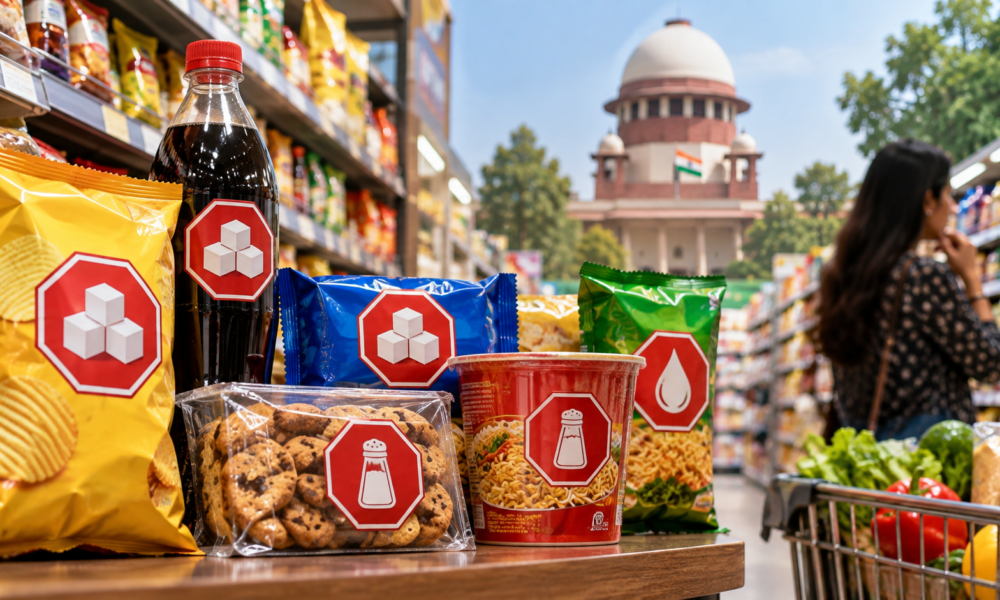
India’s packaged-food industry could face tougher front-of-pack health warnings after the government told the Supreme Court that it is open to implementing stricter labelling requirements in a single phase.
The development came during the Supreme Court’s hearing on September 10, 2026, over proposed warning labels for packaged foods high in added sugar, salt or saturated fat. The court has been examining concerns around the effectiveness and scope of India’s proposed front-of-pack nutrition labelling system.
The Food Safety and Standards Authority of India (FSSAI) had earlier proposed a system involving red-coloured hexagonal warnings on packaged foods that exceed prescribed thresholds. Under the earlier proposal, a warning would initially apply when a product crossed limits in at least two of three categories: added sugar, salt and saturated fat.
During Thursday’s hearing, however, the government indicated that it could implement the different phases together. That could mean a product containing a high level of even one of the specified nutrients would receive a red warning.
The Supreme Court has raised questions about why the proposed system should be implemented in phases, particularly given concerns surrounding children’s health and the growing burden of diet-related health problems.
The issue has also triggered a debate between public-health advocates and the food industry.
The All India Food Processors’ Association (AIFPA) has argued that nutritional thresholds should be assessed on a per-serving basis rather than the proposed per-100-gram or 100-millilitre approach. The industry says a per-serving system could better reflect how consumers actually eat packaged products.
Health advocates, meanwhile, have argued that a weaker threshold could allow products with excessive levels of a single nutrient to escape prominent warnings. Reuters reported that health groups have challenged the proposed framework and pushed for stronger consumer protection.
The proposed rules could have a significant impact on India’s packaged-food market. Large multinational companies including Nestlé, Coca-Cola, PepsiCo, Unilever and Mondelez, along with Indian companies such as ITC and Dabur, could potentially need to reconsider packaging and product communication depending on the final regulations.
The debate is ultimately about more than packaging.
Front-of-pack warnings are intended to make nutritional information easier for consumers to understand at the point of purchase. Instead of requiring shoppers to examine small-print nutritional panels, a prominent warning could immediately indicate that a product contains a high level of a particular nutrient.
FSSAI’s regulatory framework has been evolving. Its official records show amendments to the Food Safety and Standards (Labelling and Display) Regulations, 2020, including an amendment dated March 24, 2026.
The regulator has also published a draft amendment relating to safe food and balanced diets for children in schools, including definitions for foods high in added fat, added sugar or salt.
For consumers, the potential shift could make packaged-food labels much easier to interpret. For manufacturers, it could mean changes to packaging, product formulation, marketing claims and compliance systems.
The Supreme Court’s written order is expected to provide further clarity on the way forward.
The bigger question is no longer simply what is inside the packet. It is how clearly consumers should be told about it.





No Comment! Be the first one.