








India Sets December 2026 Target for Universal Access to Safe Blood as Health Ministry Reviews Blood Banks
India is accelerating efforts to strengthen its blood transfusion system, with the Ministry of Health and Family Welfare setting a December 2026 target for universal access to safe blood across the...

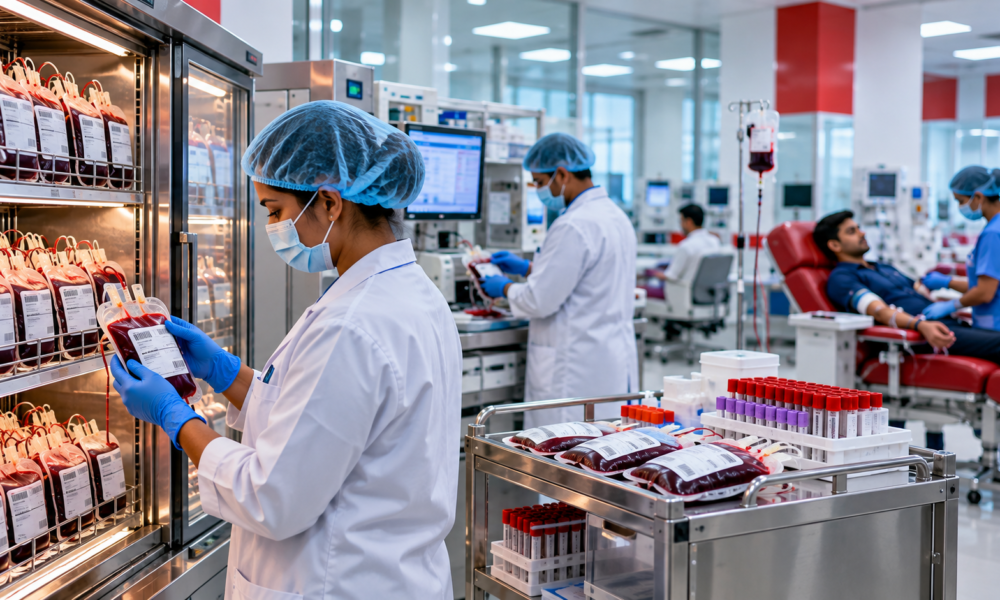
India is accelerating efforts to strengthen its blood transfusion system, with the Ministry of Health and Family Welfare setting a December 2026 target for universal access to safe blood across the country.
The Ministry conducted a national review of blood transfusion services involving all 36 States and Union Territories. The review examined blood-bank licensing, donor screening, testing for transfusion-transmitted infections, blood processing and storage, distribution and record-keeping.
The government has identified district-level availability of blood centres as one of the key areas requiring attention. According to the Health Ministry, approximately 10% of districts currently do not have a blood centre. The government has set a goal of establishing at least one blood centre in every district by December 2026.
India’s Directorate General of Health Services estimates the country’s annual blood requirement at around 14.6 million units. It currently lists 4,263 licensed blood centres operating across government, private, NGO and charitable sectors.
The availability of blood is only one part of the safety equation. Blood donations must also undergo appropriate screening and processing before being used for patients.
India’s blood-transfusion system requires donated blood to be screened for five major transfusion-transmissible infections: HIV/AIDS, Hepatitis B, Hepatitis C, syphilis and malaria. The objective is to ensure that blood and blood components are safe, accessible and of standard quality.
The latest review also highlighted gaps in digital integration. A significant number of blood centres have yet to be fully onboarded onto eRaktKosh and the Blood Bank Management System, limiting real-time visibility of blood stocks and other operational information.
The Ministry has therefore emphasised 100% onboarding of blood centres onto these digital platforms and real-time data updating.
eRaktKosh is designed as a centralised blood-bank management platform covering areas such as donor management, blood grouping, infection screening, component preparation and inventory management. Its networked approach is intended to improve visibility of available blood supplies and reduce wastage.
The government’s roadmap also includes improving voluntary blood donation, licensing compliance and standard operating procedures for blood-collection and donation camps.
States and Union Territories have been asked to strengthen component separation capacity as well. Blood can be separated into components such as red blood cells, plasma and platelets, allowing a single donation to potentially support different clinical requirements.
The Health Ministry has also called for stronger testing protocols, including the progressive adoption of advanced fourth-generation ELISA or CLIA-based screening, alongside better referral and treatment linkages for donors found reactive for transfusion-transmitted infections.
The programme increasingly combines physical healthcare infrastructure with digital monitoring. The Ministry has proposed ABDM-enabled biometric donor identification and Health Facility Registry identifiers for blood centres to improve traceability and transparency.
Implementation will involve the National Blood Transfusion Council, State Blood Transfusion Councils, CDSCO, State Food and Drug Administrations and the Indian Red Cross Society. Progress is scheduled to be reviewed through monthly and quarterly monitoring mechanisms.
The December 2026 target therefore covers more than simply increasing the number of blood banks. It involves improving geographic access, donor screening, infection testing, blood-component availability, licensing, digital inventory management and traceability.
For patients, reliable blood availability can be particularly important during emergencies, surgeries, trauma care, childbirth and treatment requiring repeated transfusions.
The Health Ministry’s latest roadmap indicates that India’s next phase of blood-transfusion reform will focus on making the system more accessible, digitally connected and quality-assured across districts.
With December 2026 approaching, states and healthcare institutions will need to address infrastructure gaps while improving donor participation and real-time management of blood inventories.






No Comment! Be the first one.