








Childhood Obesity in India: Why Schools Are Becoming a Focus of the Junk-Food Debate
India is paying increasing attention to childhood obesity and the food environment around schools. In September 2026, the Food Safety and Standards Authority of India (FSSAI) moved ahead with...

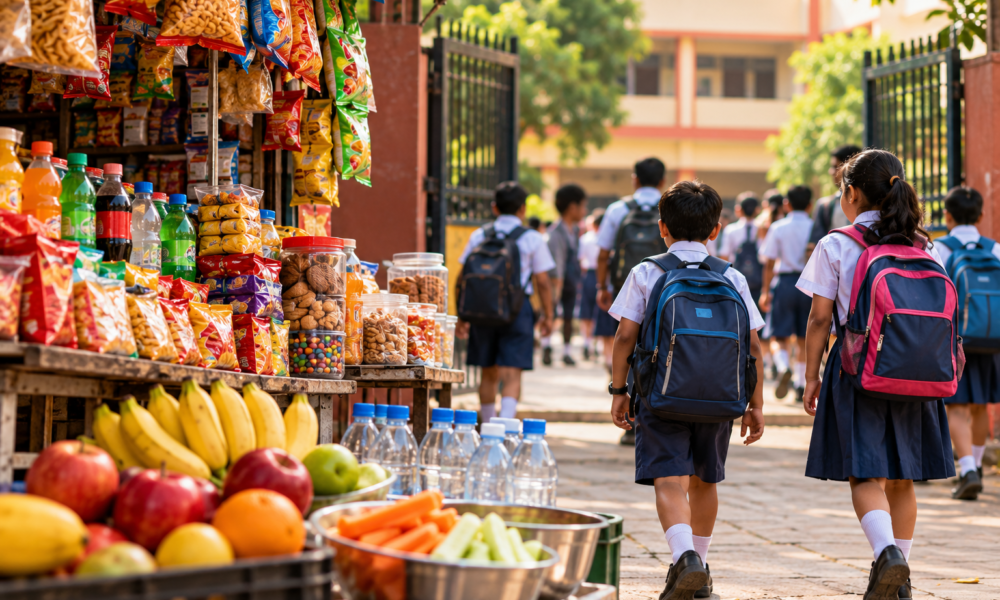
India is paying increasing attention to childhood obesity and the food environment around schools. In September 2026, the Food Safety and Standards Authority of India (FSSAI) moved ahead with proposed rules that would define foods high in added fat, added sugar or salt under its school-food regulations. The development comes as health experts continue to raise concerns about children’s growing exposure to highly processed foods and sugary products.
The proposed rules are part of a wider effort to make the food environment around children healthier. FSSAI’s draft regulations use specific nutritional thresholds to classify foods as high in added fat, sugar or salt. Under the draft, a solid food containing more than 4.2 grams of added fat per 100 grams, more than 3 grams of added sugar per 100 grams, or more than 0.625 grams of salt per 100 grams would fall within the relevant high-content category. Different thresholds are proposed for liquid foods.
Another proposal attracting attention is the restriction on the sale of high-fat, salt and sugar, or HFSS, foods within 50 metres of schools. Reuters reported in September 2026 that the proposal is moving toward implementation, with public comments being invited before the rules are finalised. The proposal could affect food vendors and small shops operating around India’s schools.
The focus on schools reflects the role that food availability can play in children’s everyday choices. UNICEF India has reported that unhealthy foods are becoming increasingly normalised in children’s diets, with high-fat, salt and sugar foods and ultra-processed products becoming more widely available. Its 2025 healthy-diet report also highlighted rising overweight and obesity among children and adolescents in India.
However, childhood obesity cannot be explained by one food or one shop. Children’s weight and health are influenced by several factors, including overall diet, physical activity, sleep, family environment, socioeconomic conditions and access to nutritious food.
This is why the school environment is important but cannot be the only focus. A child may spend several hours at school, but eating habits are also shaped at home, through advertising, social media, neighbourhood food availability and family routines.
Nutrition education can therefore play an important role alongside regulation. Children can be encouraged to understand food labels, recognise highly processed foods and choose more balanced meals. Schools can also support healthier eating by making nutritious options easier to access.
For parents, the practical approach is not to completely ban every packaged snack. Instead, meals can be built around vegetables, fruits, whole grains, pulses, nuts and other nutrient-rich foods, while foods high in added sugar, salt and fat are consumed less frequently.
India is also considering stronger front-of-pack warnings for packaged foods. Reuters reported in September 2026 that FSSAI’s latest proposal would use red warning symbols when products cross specified thresholds for salt, sugar or fat. The final rules are still being developed, meaning the regulatory framework could change before implementation.
The growing discussion around childhood obesity therefore goes beyond individual choices. It is increasingly about the environment in which children make those choices. Schools, parents, food manufacturers, retailers and policymakers all have roles to play in creating easier access to healthier diets.
For families, the simplest starting point remains a balanced diet, regular physical activity, adequate sleep and sensible limits on highly processed foods. And for children who have concerns about weight or growth, parents should consult a paediatrician or qualified healthcare professional rather than relying on restrictive diets or online advice.







No Comment! Be the first one.