







eSanjeevani Crosses 50 Crore Consultations: How India’s Telemedicine Platform Is Changing Healthcare Access
India’s national telemedicine service, eSanjeevani, has crossed 50 crore consultations, marking an important milestone in the country’s digital healthcare expansion. The platform recorded...

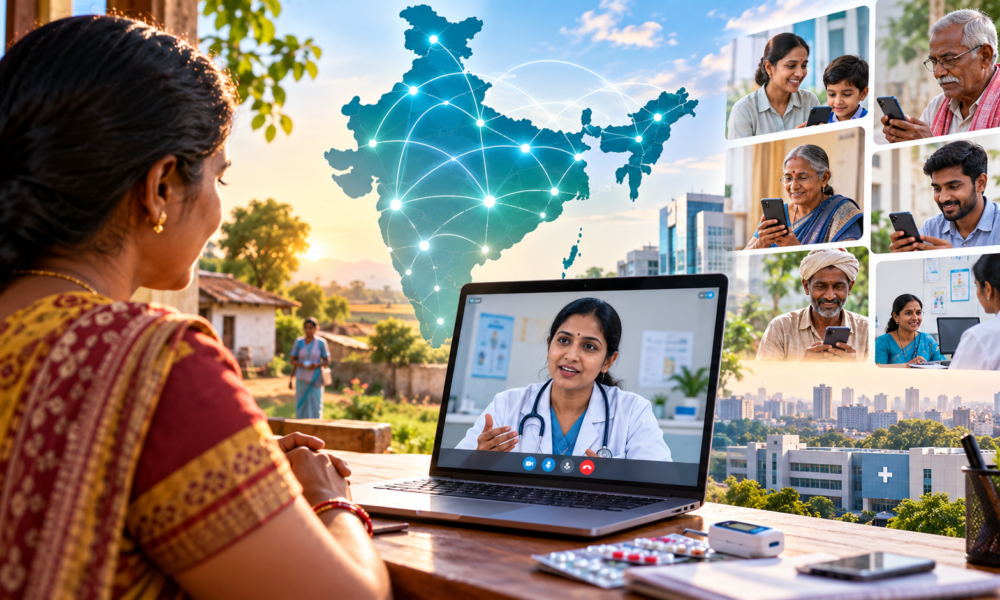
India’s national telemedicine service, eSanjeevani, has crossed 50 crore consultations, marking an important milestone in the country’s digital healthcare expansion. The platform recorded more than 50 crore consultations across all 36 States and Union Territories by September 15, 2026, according to the Ministry of Health and Family Welfare.
The achievement highlights the growing role of digital healthcare in connecting patients with doctors, particularly in rural, remote and underserved communities.
The government announced the milestone on October 6, 2026.
What Is eSanjeevani?
eSanjeevani is India’s national telemedicine service that enables patients to consult healthcare professionals remotely.
Instead of travelling to a hospital or clinic for every consultation, eligible patients can access medical advice through digital platforms.
The service uses a hub-and-spoke model that connects healthcare facilities with medical professionals and specialist institutions.
It is designed to complement physical healthcare services rather than replace hospitals, emergency departments or necessary in-person examinations.
What Does the 50-Crore Milestone Mean?
According to the government, eSanjeevani recorded 50,00,92,730 cumulative teleconsultations across all 36 States and Union Territories by September 15, 2026.
The platform supports more than 1.42 lakh Ayushman Arogya Mandir spokes, over 19,000 medical hubs and 901 online outpatient departments.
It also has more than 2.4 lakh registered healthcare providers.
The service reportedly facilitates approximately 2.5 lakh to 3 lakh consultations daily and is available in 15 languages.
These figures highlight the scale at which digital healthcare services are being used in India.
However, the number of consultations should not be confused with the number of unique patients, since one person may use the platform multiple times.
Why Are Women and Older Adults Using the Platform?
One important finding from the government’s announcement is the demographic distribution of consultations.
Women account for approximately 57.14% of eSanjeevani utilisation.
Citizens aged 46 years and above account for around 40.15% of consultations, including 16.25% from senior citizens aged 60 years and above.
This indicates that telemedicine is being used by people who may benefit from reduced travel requirements and improved access to medical advice.
For older adults and people managing long-term conditions, remote consultations can help support follow-up appointments and continuity of care when in-person examinations are not required.
How Is Artificial Intelligence Being Used?
The platform has also integrated an AI-powered Clinical Decision Support System.
This system is designed to support healthcare providers during consultations by assisting with clinical decision-making.
It does not replace doctors or independently establish a diagnosis.
The government has also integrated eSanjeevani with the Emergency Response Support System-112 to strengthen coordination between emergency services and remote medical expertise.
Additionally, specialist outpatient consultations have been introduced through institutions such as AIIMS Jodhpur, AIIMS Jammu and AIIMS Patna.
What Are the Benefits of Telemedicine?
Telemedicine can reduce the need for unnecessary travel, particularly for people living far from specialist healthcare facilities.
It can also help patients access follow-up consultations, medical advice and certain primary healthcare services more conveniently.
For rural communities, this can be particularly useful when local healthcare facilities have limited access to specialist doctors.
However, the benefits depend on reliable internet connectivity, digital literacy, access to devices and the availability of qualified healthcare professionals.
What Are the Limitations?
Not every medical condition can be assessed through a video or telephone consultation.
Patients may require physical examinations, laboratory tests, imaging or emergency medical intervention.
Digital healthcare also needs appropriate safeguards for patient privacy, medical records and secure communication.
Telemedicine should therefore complement conventional healthcare rather than become its replacement.
The Bigger Picture
eSanjeevani’s 50-crore milestone demonstrates the growing importance of digital public healthcare infrastructure in India.
Its future success will depend on improving access, maintaining clinical quality, protecting patient information and connecting digital consultations with appropriate follow-up care.
The real measure of digital healthcare is not simply how many consultations take place, but whether patients receive timely, reliable and appropriate medical support.


No Comment! Be the first one.