






How Artificial Intelligence Is Transforming Healthcare in India: From Medical Imaging to Digital Diagnosis
Artificial intelligence is becoming an increasingly important part of the global healthcare industry. From analysing medical images to supporting clinical decision-making, AI-powered technologies are...

Artificial intelligence is becoming an increasingly important part of the global healthcare industry.
From analysing medical images to supporting clinical decision-making, AI-powered technologies are creating new possibilities for healthcare providers, hospitals and patients.
India is also exploring how these technologies can strengthen healthcare delivery, particularly in a country where access to specialists and diagnostic infrastructure can vary significantly across regions.
A February 2026 backgrounder published by the Press Information Bureau highlighted the growing use of AI-powered diagnostics, telemedicine and disease surveillance tools in India’s healthcare ecosystem.
pib.gov.in
But how exactly is AI changing healthcare, and what limitations should patients understand?
- AI-powered medical imaging
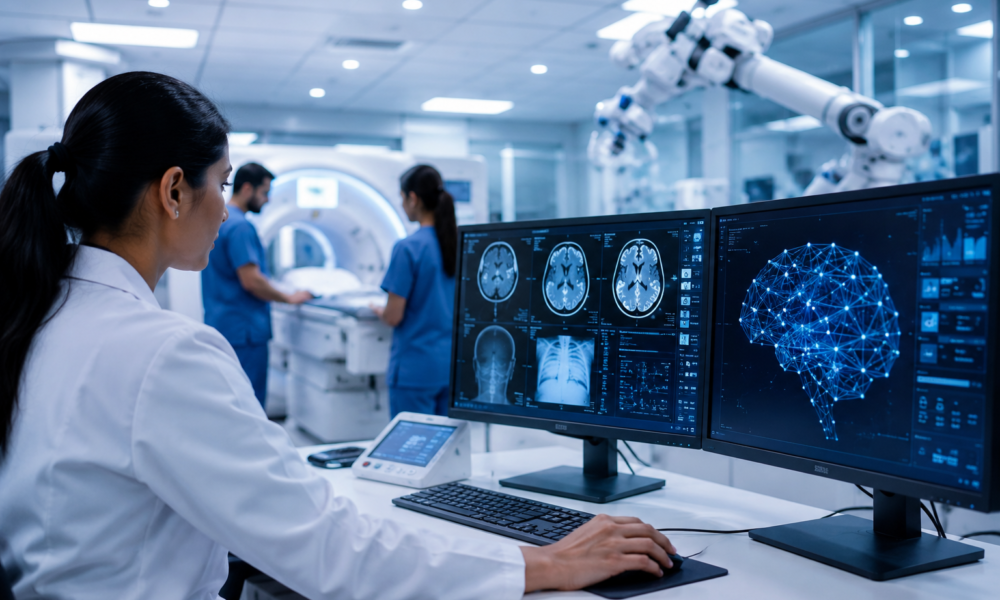
Medical imaging is one of the important areas where artificial intelligence is being explored.
AI systems can analyse radiology images and identify patterns that may require further clinical attention.
For example, specialised software can assist with analysing chest X-rays, mammograms and other medical scans.
These systems may help healthcare professionals prioritise cases or examine images more efficiently.
However, an AI-generated result should not be treated as an independent diagnosis.
Doctors must interpret findings in the context of symptoms, medical history and other investigations.
- Supporting early disease detection
AI applications are being studied for their ability to identify patterns associated with certain diseases.
In selected clinical settings, these systems can support the interpretation of medical information and assist professionals in assessing patients.
However, performance varies between applications.
A system that works well in one hospital or population may not necessarily deliver the same results in another setting.
Clinical validation is therefore essential.
- Telemedicine and remote healthcare
Telemedicine allows patients to consult healthcare professionals through digital communication platforms.
AI can support parts of this process through appointment management, administrative assistance and selected patient information workflows.
These technologies may be useful in locations where access to healthcare facilities is limited.
Nevertheless, certain medical conditions still require physical examinations, laboratory investigations or emergency intervention.
- AI in hospital administration
Hospitals manage large amounts of information, including patient records, appointments, reports and administrative documents.
AI tools can help automate selected administrative tasks, potentially allowing healthcare professionals to spend more time on patient care.
Possible applications include:
- Medical documentation support.
- Appointment scheduling.
- Patient record organisation.
- Hospital resource management.
- Administrative workflow automation.
The reliability of these systems depends on data quality, integration and human supervision.
- What is India doing in healthcare AI?
India’s broader AI ecosystem is receiving support through initiatives such as the IndiaAI Mission, approved in March 2024.
The government’s February 13, 2026 backgrounder highlighted the potential of AI, robotics and connected healthcare technologies to improve healthcare delivery.
pib.gov.in
The opportunity is particularly relevant for a country with a large population and diverse healthcare requirements.
AI may help support access, efficiency and diagnostic workflows when deployed responsibly.
What are the risks of AI in healthcare?
Despite its potential, artificial intelligence introduces several important concerns.
Patient privacy: Medical information is sensitive and must be protected against unauthorised access.
Diagnostic accuracy: AI systems can produce incorrect or incomplete outputs.
Algorithmic bias: Systems trained on limited datasets may perform differently across populations.
Overdependence: Healthcare professionals must not blindly accept automated recommendations.
Accountability: Institutions need clear systems for clinical oversight and responsibility.
Can AI replace doctors?
No.
AI can support certain medical workflows, but it does not replace the clinical judgement, communication and accountability of qualified healthcare professionals.
Doctors consider several factors when assessing patients, including symptoms, examination findings, medical history and patient preferences.
AI should be viewed as a supporting technology rather than a substitute for medical expertise.
What does the future hold?
Artificial intelligence could become an important part of India’s healthcare infrastructure.
However, its long-term value will depend on clinical validation, affordability, data protection and responsible implementation.
The real measure of healthcare AI will not simply be how advanced the technology becomes.
It will be whether it helps patients receive safer, more accessible and more effective care.
Disclaimer: AI-generated medical information should not replace consultation with a qualified healthcare professional.




No Comment! Be the first one.