






eSanjeevani Crosses 50 Crore Teleconsultations: India’s Digital Healthcare Network Expands
India’s national telemedicine service, eSanjeevani, has crossed 50 crore teleconsultations, marking a major milestone in the country’s digital healthcare infrastructure. The platform...


India’s national telemedicine service, eSanjeevani, has crossed 50 crore teleconsultations, marking a major milestone in the country’s digital healthcare infrastructure.
The platform crossed 50,00,92,730 cumulative consultations on September 15, 2026, according to the Union Health Ministry. The service now operates across all 36 States and Union Territories.
The milestone demonstrates the growing role of telemedicine in extending healthcare access beyond traditional hospitals and clinics.
50 Crore Consultations Across India
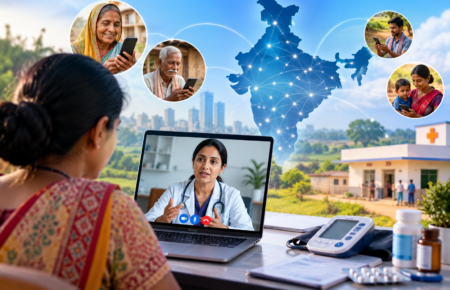
eSanjeevani currently operates through more than 1.42 lakh Ayushman Arogya Mandir spokes, 19,473 medical hubs and 901 online OPDs.
The network has more than 2.41 lakh registered healthcare providers.
This infrastructure allows patients to connect with healthcare professionals remotely, potentially reducing the need to travel long distances for consultations.
The platform has become particularly relevant for people living in rural, remote and underserved areas.
Women Account for More Than Half of Consultations
Women represent 57.14% of eSanjeevani consultations, according to government data.
Around 40.15% of consultations are availed by people aged 46 and above.
These numbers indicate that the platform is being used across different demographic groups, including people who may face barriers to accessing conventional healthcare facilities.
Telemedicine can be particularly useful for follow-up consultations, specialist advice and certain conditions where a physical examination is not always necessary.
However, it does not replace emergency medical care or every form of in-person consultation.
AI Enters India’s Telemedicine Network
eSanjeevani has also incorporated an AI-powered Clinical Decision Support System.
The system is designed to support healthcare professionals rather than replace clinical judgement.
The platform has additionally integrated emergency response services and expanded specialist consultations through institutions including AIIMS Jodhpur, AIIMS Jammu and AIIMS Patna.
This represents an evolution from basic remote consultations toward a broader digital healthcare ecosystem.
Why Telemedicine Matters
India’s geography makes healthcare access uneven.
Large cities have extensive networks of hospitals and specialists, while rural and remote communities can face longer travel times and shortages of specialised medical services.
Telemedicine can help bridge some of these gaps by allowing healthcare providers to connect with patients remotely.
The technology can also reduce travel costs and make follow-up care more convenient.
However, the quality of telemedicine depends on internet connectivity, digital literacy, healthcare availability and the ability of doctors to determine when an in-person examination is necessary.
The Next Phase of Digital Healthcare
Crossing 50 crore consultations is therefore more than a numerical milestone.
It demonstrates that digital healthcare can operate at population scale.
The government’s continued expansion of eSanjeevani, along with AI-supported clinical tools and specialist consultations, suggests that India’s digital health infrastructure is moving toward a more integrated model.
The challenge now is ensuring that digital healthcare remains accessible, clinically appropriate and connected to physical healthcare services.
With 50 crore consultations already completed, eSanjeevani has become one of the most significant components of India’s public digital-health infrastructure.




No Comment! Be the first one.