






India’s Digital Health Network Crosses 105 Crore Records, Opening New Era for Connected Healthcare
India’s digital healthcare infrastructure has reached a major milestone, with more than 105 crore health records linked to Ayushman Bharat Health Accounts (ABHA) under the Ayushman Bharat Digital...

India’s digital healthcare infrastructure has reached a major milestone, with more than 105 crore health records linked to Ayushman Bharat Health Accounts (ABHA) under the Ayushman Bharat Digital Mission (ABDM).
The development is transforming how medical information can move between patients, hospitals, laboratories and other healthcare providers, while creating a digital foundation for areas such as telemedicine, health analytics and artificial intelligence. The latest government review reported more than 93.95 crore ABHA numbers, 105 crore linked health records, 5.33 lakh registered health facilities and 9.85 lakh healthcare professionals on the national digital health registries.
From paper files to portable health records
ABDM was launched in 2021 with the objective of building an interoperable digital health ecosystem across India.
At its centre is the ABHA number, a 14-digit health identifier that can link a person’s health records across participating hospitals, laboratories, pharmacies and other healthcare services, subject to the individual’s consent. The system is designed to allow patients to access and share their records digitally rather than repeatedly carrying physical reports between healthcare providers.
This could be particularly useful for patients who receive treatment from multiple hospitals or move between cities. Instead of rebuilding a medical history from scratch, an ABDM-enabled provider can access relevant records when the patient gives permission.
Healthcare facilities are joining the network
The digital infrastructure extends beyond individual patients.
Government data shows 5.33 lakh health facilities and 9.85 lakh healthcare professionals have been registered on ABDM’s national digital registries. Around 2.72 lakh healthcare facilities have adopted ABDM-enabled software.
The system also includes the Health Facility Registry and Healthcare Professionals Registry, creating a common digital layer for hospitals, clinics, laboratories, pharmacies and healthcare workers.
Another feature is Scan & Register, which allows participating facilities to use digital registration systems to reduce queues at outpatient departments. The government said the platform had generated around 24 crore Scan & Register tokens by July 2026.
Digital records could support AI in healthcare
The significance of ABDM extends beyond convenience.
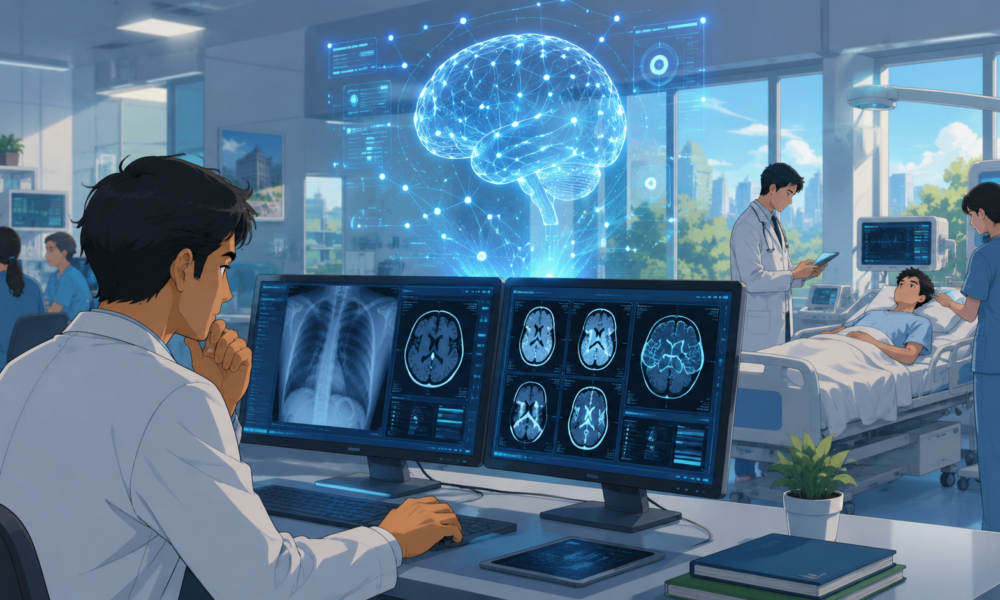
A large interoperable health-data ecosystem can potentially support better healthcare planning, disease surveillance, diagnostics and research. The government says anonymised health data generated through the digital ecosystem could contribute to India’s emerging healthcare AI ecosystem.
IndiaAI and the Indian Council of Medical Research (ICMR) have separately established a framework to support responsible AI applications in healthcare. Under their collaboration, anonymised and ethics-approved biomedical datasets can be made available through the AIKosh platform, while IndiaAI provides access to GPU and high-performance computing infrastructure.
This creates a potential connection between India’s digital health records infrastructure and its growing AI ecosystem, although digital records alone do not automatically translate into clinically useful AI tools.
Privacy and consent remain important
The expansion also makes data governance an important part of digital healthcare.
ABDM’s architecture is designed around consent-based sharing. According to the government, healthcare providers can access previous records after obtaining patient consent, with health information exchanged through revocable, time-bound consent mechanisms.
That means the success of digital healthcare will depend not only on how many records are connected, but also on how effectively privacy, cybersecurity, consent and data quality are maintained.
What comes next?
The next stage is shifting from creating digital infrastructure to increasing its everyday use.
The Mission Steering Group has said the focus should now be on maximising adoption and utilisation across the country. That includes greater participation by states, healthcare providers and private-sector health technology companies.
For patients, the long-term objective is straightforward: a healthcare system where medical information can move securely with them, rather than remaining trapped inside individual hospitals.
For India’s healthcare sector, ABDM is becoming another piece of national infrastructure, sitting alongside hospitals, laboratories, insurance systems, telemedicine and emerging AI platforms.
This article is for informational purposes and does not constitute medical advice.







No Comment! Be the first one.