


Rabies: No Cure, But Prevention for Sure!
Rabies remains a serious but preventable public health threat. With timely wound care, post-exposure vaccination, responsible pet ownership and community participation, we can move closer to a...
Rabies: No Cure, But Prevention for Sure!
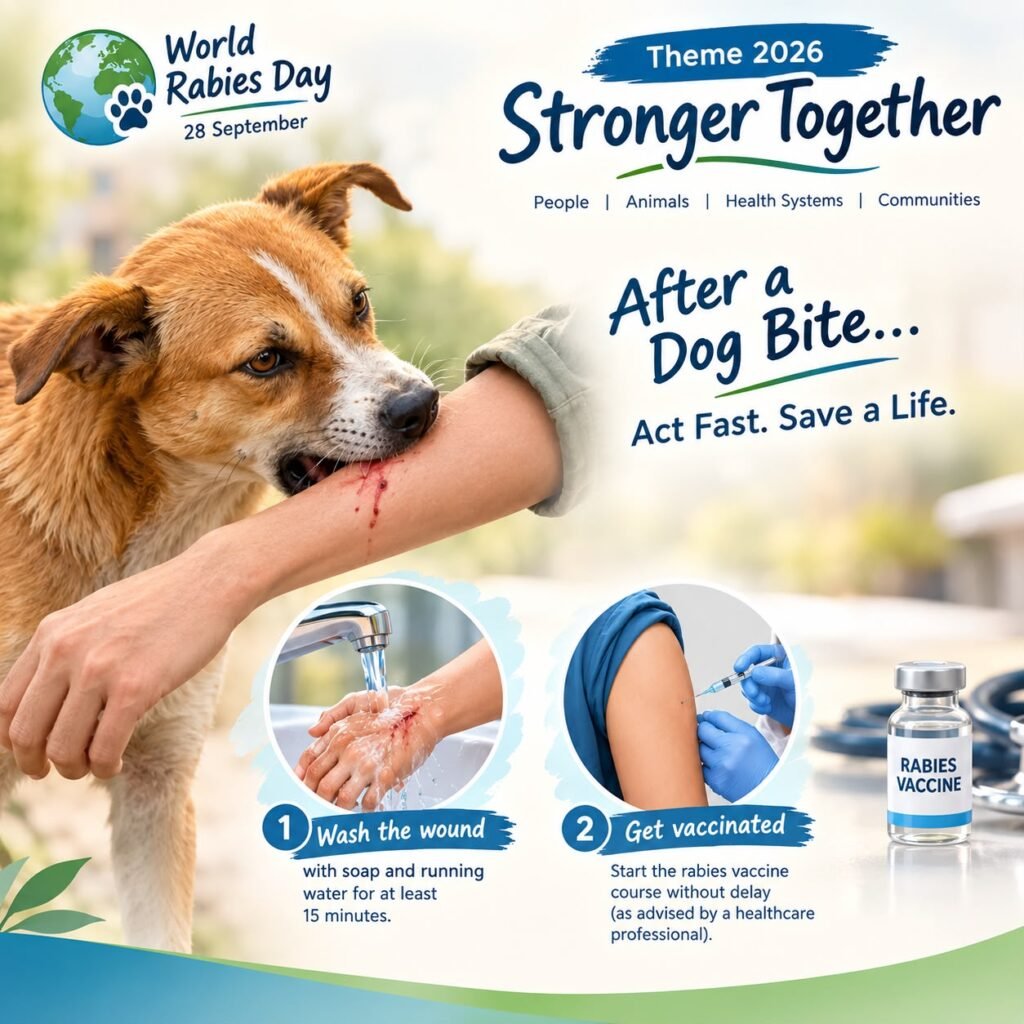
Every year, 28th September reminds us that rabies is a disease we can prevent and ultimately eliminate through timely action and collective responsibility. World Rabies Day 2026 is being observed under the theme “Strong Together”, highlighting that rabies elimination cannot be achieved by one person, one profession or one sector alone. It requires communities, healthcare workers, veterinarians, governments and organizations to work together through awareness, timely post- exposure care, responsible animal vaccination and sustained public health efforts.
So, Let’s talk about rabies – because today 28th September, the world comes together to observe World Rabies Day. This is not just a random date on calendar as it marks the death anniversary of the great scientist Louis Pasteur, who developed the first rabies vaccine.
Rabies is among the oldest and deadliest diseases known to mankind. It is caused by a virus transmitted from animals to humans through saliva via bites, scratches or direct contact with mucosa such as eyes, mouth, or open wounds. In up to 99% of human rabies cases, dogs are responsible for virus transmission. Rabies infects mammals including dogs, cat, livestock and wildlife. Children between the age of 5 and 14 years are particularly vulnerable and often the most frequent victims. This deadly virus attacks the nervous system and can cause death if not treated. There is no cure for rabies once the symptoms appear but the disease is 100% preventable with timely vaccination.
Every year, Rabies kills an estimated 59,000 people worldwide, mostly reported from Africa and Asia. According to WHO, about 36% of the world’s rabies deaths occur in India, making it a major public health concern. In India, the problem is not that rabies cannot be prevented, but that many people still lose their lives due to lack of awareness, delayed treatment or dependence on home remedies. Sometimes, fear also plays a role. Not long ago, there was a heartbreaking case of a child who was bitten by a dog while playing. Out of fear of being scolded he hid the incident from his parents. By the time symptoms appeared, it was too late and the child lost his life. Stories like these remind us why awareness and open conversations are as important as vaccines in saving lives.
How can rabies be prevented?
Post-exposure prophylaxis:
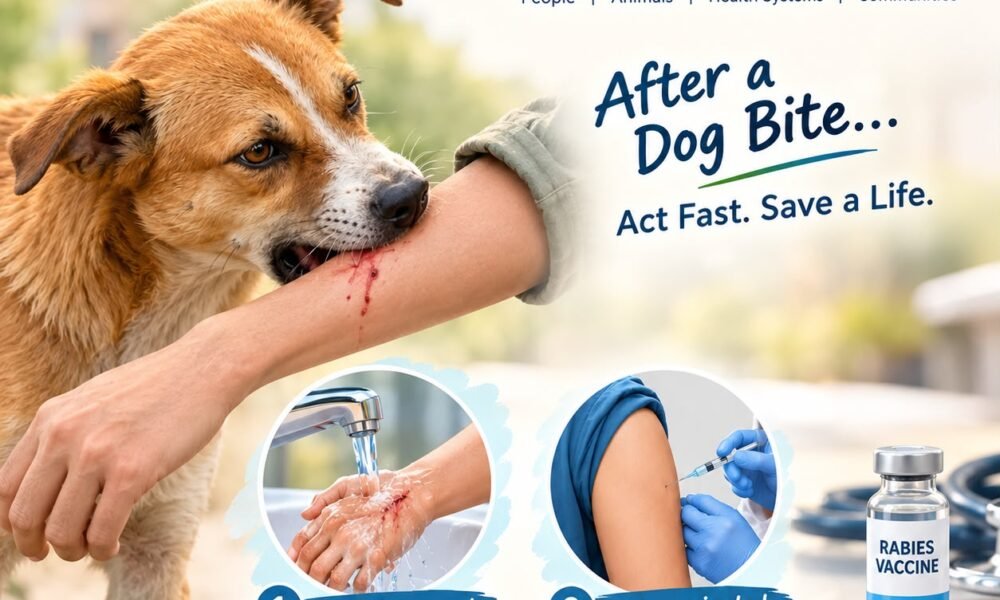
The first line of defence after a bite is surprisingly very simple- just wash the wound and scratches immediately with soap and running water for at least 15 minutes. If soap is not available, flush with water alone. Wound washing is the most effective first aid treatment against rabies, as it removes as much virus as possible from the wound site before it can be absorbed into the nerve endings. Avoid applying irritants to wound such as chili powder, turmeric, plant juices, acids or alkalis and do not cover the wound with dressings or bandages.
After cleaning the wound, next step is to start the vaccination course without delay. Usually, 4-5 doses are given according to regimen. The most important thing is to complete the course – do not stop in between. Even if someone forgets a dose, it’s never too late to continue. Depending on the severity of the bite, rabies immunoglobulins may also be required.
Importantly, there are no age restrictions- even infants, pregnant and lactating women can also safely take rabies vaccine.
Pre-exposure prophylaxis:
This is recommended for people at higher risk such as veterinarians, animal handlers, health workers. It is given in three doses on day 0, day 7 and day 21 or 28 and protects them in case of accidental exposure.
Dog vaccination:
As 99% of human rabies cases are caused by dog bite, vaccination of dogs is the most powerful way to break the chain of transmission. When we do mass dog vaccination we are not just protecting them but also protecting the entire community. Responsible pet owners should ensure their pets are vaccinated regularly and street dog vaccination campaigns are equally important for public health.
We all know or often heard of vaccination as the key to prevention, but in real life many lives could be saved if people knew how to spot a rabid dog in time.
The warning signs include: sudden aggression without reason, unusual or restless behaviour, weakness or paralysis, change in barking or growling and excessive drooling or foaming at the mouth. Rabies is not just about dogs, once virus enters human the disease develops its own signs and symptoms: it often starts with pain, tingling, or itching at the bite site. Soon symptoms like anxiety, confusion agitation or even hallucination may appear. People may develop fear of water or even fear of moving air, difficulty in swallowing, restlessness and excessive salivation. Sadly, once clinical symptoms appear, rabies almost always leads to death within a week.
The 2026 theme: “Stronger Together” is more than just a theme or a slogan; it’s actually a reminder that rabies prevention is a shared responsibility. Protecting communities requires coordinated action across human health, animal health and the wider environment- the essence of a One Health approach. Rabies is preventable and when communities and health systems work together, each of us can take responsibility and contribute to eliminating rabies deaths. Even a small action today, like vaccinating a pet or helping someone receive prophylaxis timely, can save a life tomorrow.
Dr. Rukhsar Khan
Dr. Rukhsar Khan, MBBS, MD (Community Medicine), is a Senior Resident in the Department of Community Medicine at Pt. Jawaharlal Nehru Memorial Medical College, Raipur, Chhattisgarh. She completed her MBBS from Jamia Hamdard, New Delhi. Her academic and research interests include epidemiology, non-communicable diseases, health systems strengthening, evidence-based public health, health promotion and palliative care. She has experience in implementation research on non-communicable diseases, with particular emphasis on underserved and tribal populations.


No Comment! Be the first one.