







IndiaAI, AYUSH Ministry Sign MoU to Bring AI into Traditional Healthcare
IndiaAI and the Ministry of AYUSH have recently signed a Memorandum of Understanding (MoU) to boost AI-led innovation in India’s traditional medicine ecosystem. The MoU was signed by Kavita...

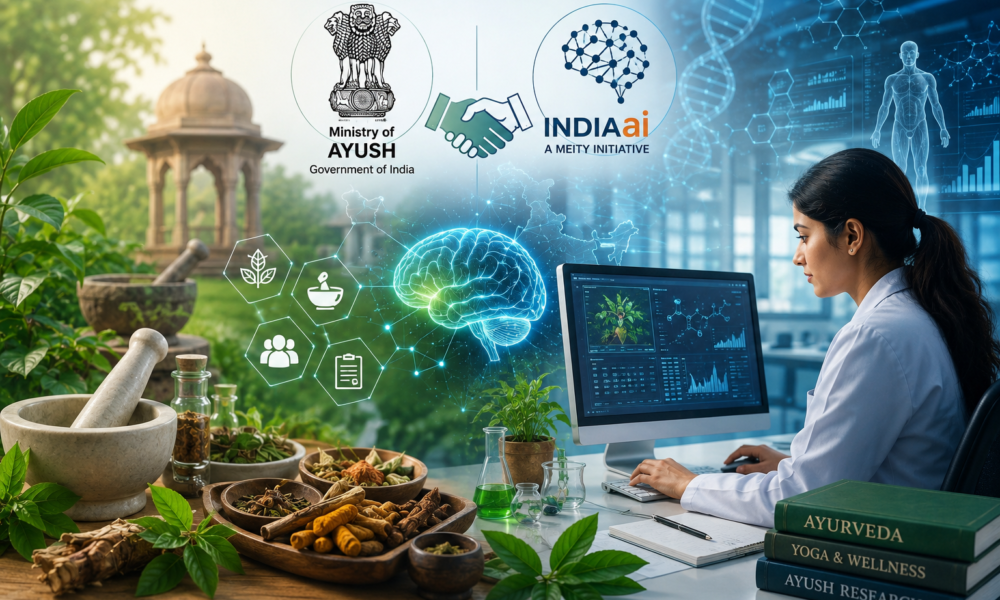
IndiaAI and the Ministry of AYUSH have recently signed a Memorandum of Understanding (MoU) to boost AI-led innovation in India’s traditional medicine ecosystem. The MoU was signed by Kavita Garg, Joint Secretary at the Ministry of AYUSH, and Shri Sudeep Shrivastava, COO of the IndiaAI Mission and Joint Secretary at the Ministry of Electronics and Information Technology.
This is a first step towards bringing Artificial Intelligence into healthcare, with IndiaAI and the Ministry of AYUSH working together to strengthen research, digital healthcare, knowledge management and the use of technology across the AYUSH sector.
Through this partnership, the Ministry of AYUSH aims to support researchers, start-ups, academia and innovators in developing responsible AI solutions for the AYUSH sector.
Under the agreement, the Ministry of AYUSH will join hands with AIKosh, IndiaAI’s national platform for AI-related data, models and other resources. Eligible and anonymised health research material from the AYUSH sector will be shared through the platform, with the aim of providing researchers and start-ups with access to a wider pool of information for developing healthcare applications.
The material can include datasets, metadata, AI models, toolkits and relevant use cases. Making these resources available in a structured format will help researchers study traditional medicine using modern data tools while following regulatory requirements.
The partnership is also expected to give stakeholders in the AYUSH sector access to computing resources through the IndiaAI Compute ecosystem. This is important because developing and testing AI systems requires considerable computing capacity, particularly when handling large datasets.
The two ministries have identified several possible areas for the use of AI, including research, medicinal plants, drug administration and capacity building. AI could help researchers process large amounts of information, identify patterns in research data and develop tools that support healthcare professionals. However, such applications will still require scientific validation and appropriate oversight before they can be used widely.
The agreement comes as the Ministry of AYUSH continues to expand its digital infrastructure. In July, the ministry stated that its Ayush Grid initiative had developed 24 e-governance platforms, while its main portal had mapped more than 6,000 AYUSH facilities as of July 2026. The ministry is also using AI-enabled chatbots and the AYUSH Hospital Management Information System to support digital healthcare delivery.
The latest partnership could therefore add an AI research layer to an existing digital push, creating opportunities for Indian technology companies and start-ups in the health sector.
For patients, the immediate impact is unlikely to be the arrival of an “AI-powered” treatment. Instead, the larger impact could come through the development of datasets and research systems needed to test whether technology can improve healthcare services.
The partnership will initially run for two years, with the possibility of renewal through mutual agreement. The ministries have stated that the MoU carries no financial commitment or liability for either side.
The development points to a wider change in India’s healthcare ecosystem, where traditional medicine and digital technology are increasingly being brought into the same conversation. The real test of the partnership will be whether it can produce reliable evidence, improve research quality and offer practical health benefits to healthcare workers and patients.







No Comment! Be the first one.