








Smart Wearables, 3D Printing and AI Diagnostics: How Precision Medicine Is Transforming Healthcare
Healthcare is entering a new phase in which medical technology is increasingly focused on individual patients rather than standardised treatment approaches. Smart wearables, three-dimensional...

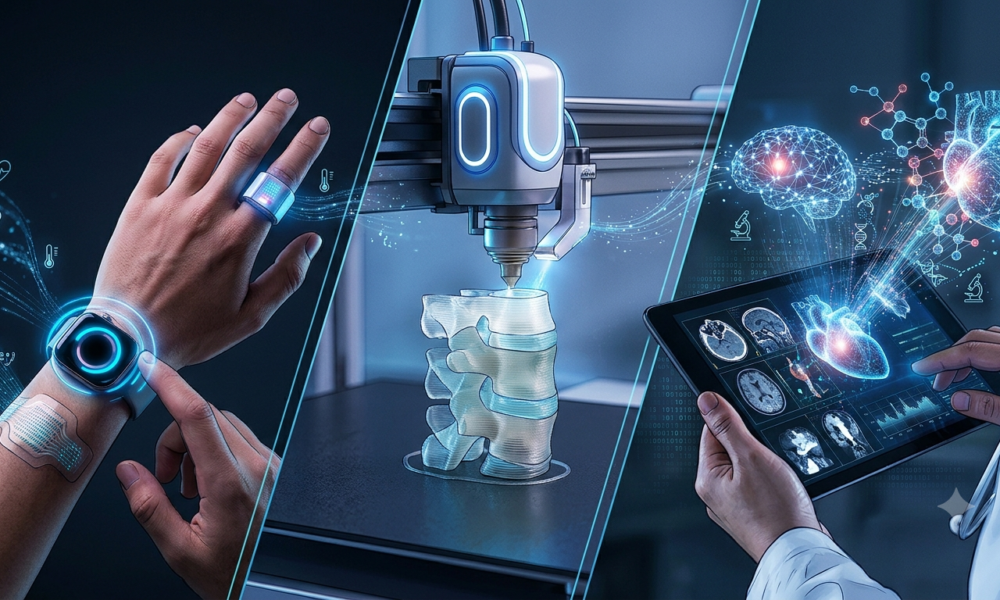
Healthcare is entering a new phase in which medical technology is increasingly focused on individual patients rather than standardised treatment approaches. Smart wearables, three-dimensional printing and artificial intelligence are creating new possibilities for monitoring health, planning procedures and identifying diseases.
These technologies are also changing how hospitals, medical researchers and healthcare companies approach precision medicine.
Smart Wearables Are Moving Beyond Fitness Tracking
Smartwatches and wearable health monitors are increasingly capable of tracking physiological information, including heart rate, sleep patterns, physical activity and, in certain devices, blood oxygen levels and other health indicators.
Their potential role in healthcare extends beyond personal wellness.
The US Government Accountability Office, in an August 2026 technology assessment, highlighted how wearable devices could contribute to clinical decision-making through continuous monitoring, patient-specific health baselines and remote patient monitoring.
For clinicians, access to longer-term health information could provide additional context when evaluating symptoms and managing chronic conditions.
Medical-grade devices and regulated monitoring systems may also support the management of patients outside traditional hospital settings.
However, consumer wearables should not automatically be treated as medical diagnostic equipment. Accuracy varies between devices, and integrating wearable information into electronic health records presents technical, privacy and clinical workflow challenges.
3D Printing Is Making Medical Treatment More Personalised
Three-dimensional printing is another technology expanding the possibilities of precision medicine.
Instead of producing identical medical components, additive manufacturing allows researchers and healthcare professionals to develop objects shaped around individual patient anatomy.
Applications include patient-specific anatomical models, surgical planning tools, customised orthopaedic implants and radiotherapy accessories.
A major development came in April 2026, when the American Association of Physicists in Medicine published Task Group Report 336, outlining quality assurance and quality control considerations for 3D printing in medical imaging and radiation therapy.
The technology can be used to manufacture patient-specific immobilisation devices, custom bolus materials and specialised radiotherapy equipment.
These applications can help improve treatment positioning and support more accurate radiation delivery.
In orthopaedics, patient-specific implants offer another promising application. A 2026 scoping review in the Journal of Orthopaedic Surgery and Research examined 12 studies involving 108 patients with traumatic bone defects.
The review reported encouraging clinical outcomes but noted that the available evidence remains limited and largely based on retrospective studies and case series.
AI and Nanomedicine Are Expanding Diagnostic Possibilities
Artificial intelligence is increasingly being investigated for medical imaging, clinical decision support, biomarker discovery and personalised treatment planning.
AI systems can analyse complex medical information and identify patterns that may be difficult to detect through conventional analysis alone.
A September 2026 review in BMJ Digital Health and AI highlighted the rapid progress of clinical AI while warning that real-world safety evaluations and prospective clinical trials remain limited.
Another emerging research area involves extracellular vesicles.
These microscopic, cell-derived structures carry biological material, including proteins, lipids and nucleic acids. Researchers are studying whether their molecular contents can help identify disease-related changes.
The National Institutes of Health highlighted extracellular vesicles in a March 2026 research priority focused on developing nanotechnology tools for early disease detection, therapeutics and drug delivery.
Combining AI-based analysis with advanced molecular testing could eventually improve biomarker interpretation and support more personalised diagnostics.
However, these technologies still face challenges involving standardisation, clinical validation, affordability and regulatory approval.
The Future of Precision Healthcare
The convergence of wearable monitoring, 3D printing, AI and nanomedicine could make healthcare more individualised and data-driven.
For hospitals, the next challenge will be integrating these technologies into everyday clinical workflows while protecting patient information and maintaining medical oversight.
For patients, innovation will matter most when it produces measurable improvements in diagnosis, treatment safety, accessibility and quality of life.
Precision medicine is advancing, but its success will ultimately depend on reliable evidence rather than technological promise alone.






No Comment! Be the first one.