







Delhi-NCR’s Air Pollution Crisis: How Air Purifiers Can Help Protect Indoor Health
As air quality deteriorates across northern India during winter, concerns about respiratory health are extending beyond outdoor pollution. More households are exploring air purifiers, indoor...

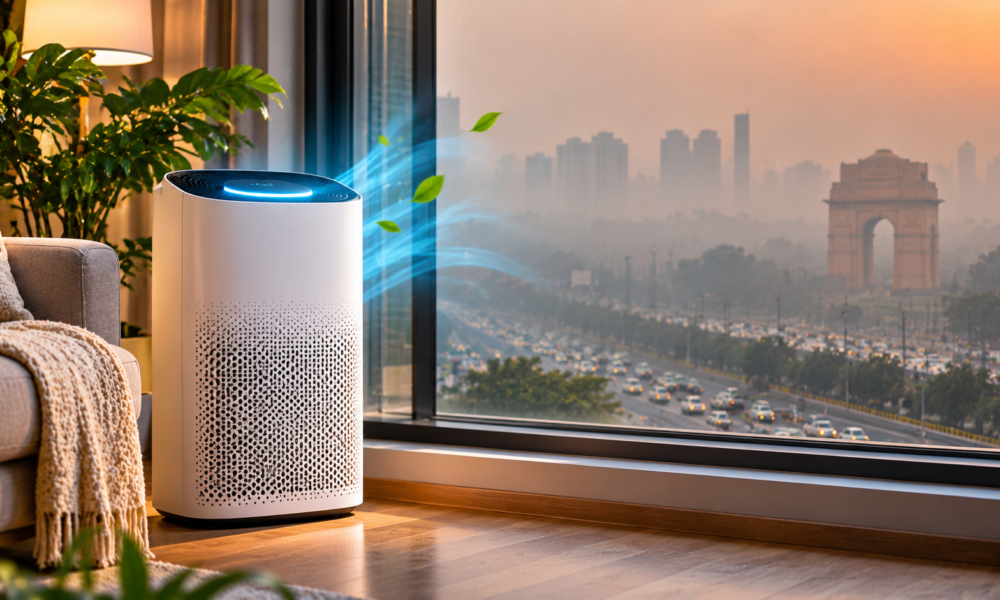
As air quality deteriorates across northern India during winter, concerns about respiratory health are extending beyond outdoor pollution. More households are exploring air purifiers, indoor air-quality monitors and other measures to reduce their exposure to airborne pollutants.
This growing interest is also visible in online searches. An analysis of five years of Google Trends data collected on November 19, 2026, found that Indian searches for air purifiers increase nearly eightfold between July and November.
November recorded the highest average search interest in the five-year dataset.
Why is indoor air quality becoming important?
Air pollution is not restricted to roads, construction sites and industrial areas.
Indoor environments can also contain particulate matter, dust, smoke and other pollutants. Cooking activities, inadequate ventilation and outdoor pollution entering through doors and windows can contribute to indoor exposure.
Fine particulate matter, particularly PM2.5, is a concern because these particles can penetrate deep into the respiratory system.
The World Health Organization identifies air pollution exposure as a major risk factor for cardiovascular and respiratory diseases.
Can air purifiers actually help?
Air purifiers equipped with appropriately sized HEPA filters can reduce airborne particulate matter in indoor environments.
However, their effectiveness depends on several factors:
- The size of the room.
- The purifier’s Clean Air Delivery Rate (CADR).
- Filter quality and maintenance.
- Placement and operating duration.
- The amount of pollution entering the room.
A purifier should be selected according to the room’s dimensions rather than simply its advertised coverage.
It is also important to understand that air purifiers do not eliminate every indoor pollutant. HEPA filters primarily target airborne particles, while gases and volatile organic compounds require different filtration technologies.
What else can households do?
Air purifiers should be part of a broader indoor air-quality strategy.
Households can reduce exposure by keeping windows closed during severe outdoor pollution episodes, maintaining ventilation when outdoor conditions permit, avoiding indoor smoking and ensuring that cooking areas have appropriate exhaust systems.
Regular cleaning and maintenance of air-conditioning systems can also help maintain indoor air quality.
Who should pay particular attention?
Children, older adults and people with existing respiratory or cardiovascular conditions may be more vulnerable to air pollution.
Individuals experiencing persistent coughing, wheezing, breathing difficulties or chest discomfort should seek medical assessment rather than relying exclusively on air-quality products.
The bigger picture
The growing interest in air purifiers reflects a wider shift towards preventive healthcare.
However, individual households cannot solve India’s air pollution problem through consumer products alone.
Reducing emissions from transport, industry, construction and other sources remains essential.
For consumers, the priority should be understanding indoor air quality, selecting suitable filtration equipment and reducing exposure wherever possible.



No Comment! Be the first one.