








Doomscrolling Before Bed: How Late-Night Scrolling Can Affect Your Sleep, Mood and Focus
One more reel, one more headline, one more notification. Late-night phone use can push bedtime further away and interfere with sleep. Here’s what the research says and how to break the habit....

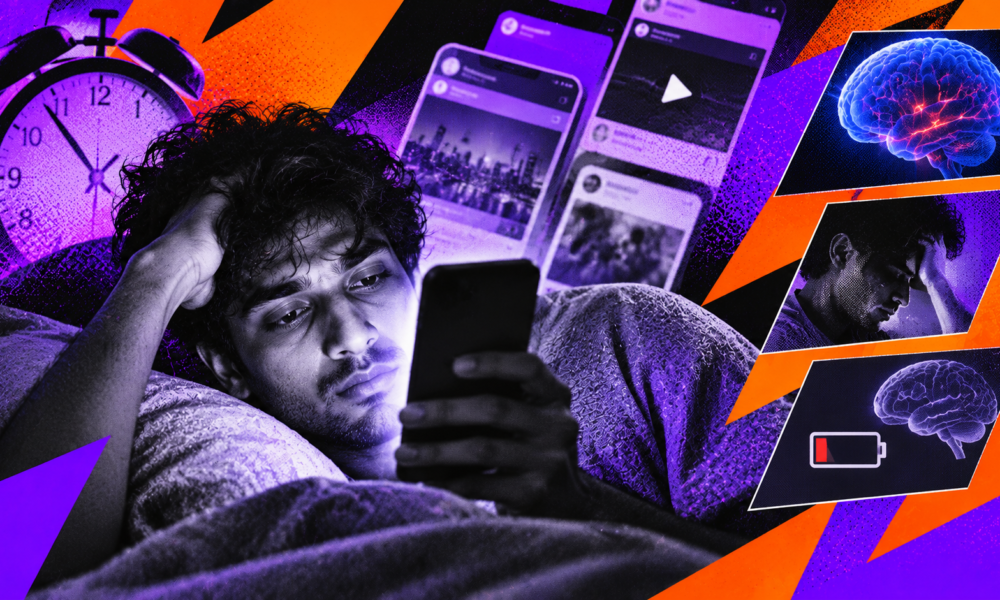
One more reel, one more headline, one more notification. Late-night phone use can push bedtime further away and interfere with sleep. Here’s what the research says and how to break the habit.
You tell yourself you will check your phone for five minutes before sleeping. Then one video becomes ten, a news update leads to another search, and suddenly it is much later than you planned.
This habit is often described as doomscrolling: repeatedly consuming negative, alarming or emotionally draining content online. But late-night scrolling is not limited to distressing news. Reels, gaming videos, celebrity updates, messages and endless social media feeds can all keep people looking at their screens long after they intended to sleep.
The concern is not simply the time spent on a phone. Screen use can delay bedtime, expose people to stimulating content and make it harder to switch from an alert state to a relaxing bedtime routine.
Research published in JAMA Network Open in March 2025 examined screen use before bed among more than 122,000 adults. Daily screen use in the hour before bedtime was associated with a 33% higher prevalence of poor self-reported sleep quality and around 7.6 fewer minutes of sleep on workdays compared with no screen use. The researchers estimated that the difference could add up to approximately 48 minutes less sleep each week.
The study found an association, not proof that phone use directly caused poor sleep. Nevertheless, it adds to evidence that bedtime screen habits deserve attention.
What is doomscrolling?
Doomscrolling refers to the repeated consumption of negative or distressing online content, often for longer than intended.
It may involve reading about accidents, crime, political conflict, disasters, financial uncertainty or other worrying events. The habit can also be driven by the desire to stay informed, check for updates or avoid missing something important.
Social media platforms make continued browsing easy through features such as:
- Infinite scrolling.
- Autoplay videos.
- Personalised recommendations.
- Continuous notifications.
- Frequently refreshed news feeds.
- Short-form videos that move quickly from one topic to another.
Not everyone who uses a phone before bed is doomscrolling. However, both prolonged browsing and emotionally intense content can make it difficult to disengage and settle down for sleep.
How can late-night scrolling affect sleep?
- It can push bedtime later
One of the simplest ways phone use affects sleep is by taking up time that would otherwise be spent sleeping.
A person planning to sleep at 11 pm may continue browsing until midnight or later. If the wake-up time remains unchanged because of work, college or family responsibilities, the lost time can reduce total sleep.
The 2025 JAMA Network Open study found that adults reporting daily screen use in the hour before bed went to bed later and slept for less time on average than those reporting no screen use.
- Screen light may interfere with the body’s sleep signals
Light exposure plays a role in regulating the body’s internal clock, also known as the circadian rhythm.
Bright light in the evening can signal alertness to the brain. Light from phones, tablets and computers may contribute to delayed sleep timing, particularly when devices are used close to bedtime.
However, screen light is not the only factor. The time spent browsing, the type of content being consumed and the stimulation associated with notifications can also matter.
- Emotionally intense content can keep the mind alert
Reading upsetting news, watching arguments or following stressful discussions may leave a person feeling worried, frustrated or mentally activated.
Instead of transitioning into a relaxed bedtime routine, the mind may continue processing what was seen online.
This does not mean every negative post will disrupt sleep. The effect varies between individuals and depends on the content, timing and person’s response.
- Notifications can interrupt the wind-down process
A message, breaking-news alert or social media notification can pull attention back to the phone even after someone has decided to stop browsing.
Checking one notification can lead to several more minutes of scrolling. Repeated interruptions can make it harder to maintain a consistent bedtime routine.
Keeping the phone on silent or using a scheduled Do Not Disturb setting can reduce these interruptions.
- Poor sleep can affect the following day
Sleep supports attention, memory, mood and everyday functioning.
When late-night phone use repeatedly reduces sleep time, people may find it harder to concentrate at work or college, manage daily responsibilities or maintain a regular routine.
The CDC notes that adequate sleep supports attention and memory, as well as physical and mental health.
For people who commute, operate machinery, drive or perform tasks requiring sustained attention, insufficient sleep can also become a safety concern.
What does research say about phone use before bed?
Research increasingly finds an association between screen use near bedtime and poorer sleep outcomes.
A March 2025 study published in JAMA Network Open analysed survey responses from 122,058 adults in the United States. It found that daily screen use during the hour before bed was associated with:
A 33% higher prevalence of poor self-reported sleep quality.
Approximately 7.6 fewer minutes of sleep on workdays.
Later bedtimes.
An estimated 48 minutes less sleep across a week.
A separate 2024 study published in the journal Sleep Medicine examined bedtime media use among 4,188 adults in Switzerland. Frequent screen use during the 30 minutes before sleep was associated with later bedtimes, shorter sleep duration and greater daytime sleepiness.
These studies are observational. They cannot establish that screen use alone caused the reported sleep problems. Stress, work schedules, mental health, existing sleep difficulties and other lifestyle factors may also influence the relationship.
The findings nevertheless suggest that late-night screen habits are worth examining, particularly when they repeatedly delay sleep.
7 practical ways to stop late-night scrolling
Changing a phone habit can be difficult because browsing is often automatic. The aim is to make it easier to stop, rather than relying entirely on willpower.
- Set a phone cut-off time
Choose a time when you stop browsing before your planned bedtime. The National Institutes of Health recommends using the hour before bed for quiet activities and limiting electronic screens during this period.
Start with a realistic target if an hour feels difficult. Consistency matters more than setting an ambitious rule that you cannot maintain.
- Keep your phone away from the bed
Charge your phone on a desk or another surface away from your pillow. This makes it less convenient to pick up the device every time you wake up or feel bored.
If you use your phone as an alarm, consider placing it far enough away that you must get up to switch it off.
- Turn off non-essential notifications
Disable alerts from social media, shopping apps, games and other non-essential services at night.
Use Do Not Disturb or Focus settings to reduce interruptions. Keep emergency contacts or important calls accessible according to your needs.
- Avoid stressful content close to bedtime
Try not to make the final part of your day a continuous stream of disturbing headlines, arguments or emotionally intense videos.
If you want to stay informed, set aside a specific time earlier in the day to check the news rather than repeatedly refreshing updates at night.
- Replace scrolling with a relaxing activity
Give your attention something else to do.
You could read a printed book, listen to calming music, write down tomorrow’s tasks, practise gentle breathing or take a warm shower.
The purpose is to create a predictable transition between daily activity and sleep.
- Use app limits and grayscale settings
Set app timers for platforms where you frequently lose track of time. Some devices also offer grayscale displays, bedtime modes and scheduled screen restrictions.
These features cannot guarantee better sleep, but they can add friction to automatic browsing.
- Keep a simple sleep and screen diary
For one week, note when you stop using your phone, when you go to bed, when you wake up and how rested you feel.
This can help identify patterns. For example, you may notice that late-night videos regularly push bedtime back or that stressful news leaves you feeling unsettled.
Use the observations to make one or two practical changes.
Is blue light the only reason phones affect sleep?
No. Blue light receives considerable attention, but it is not the whole story.
Late-night phone use can affect sleep through several overlapping pathways:
Time displacement: Browsing takes time away from sleep.
Light exposure: Bright screens may influence circadian timing.
Mental stimulation: Exciting or distressing content can keep the mind engaged.
Notifications: Alerts can interrupt attempts to relax or sleep.
Habit formation: Repeated checking can become an automatic bedtime behaviour.
This is why simply enabling a blue-light filter may not solve the problem. Reducing screen time before bed and changing the browsing routine may be more useful.
When should you seek professional help for sleep problems?
Occasional difficulty sleeping can happen to anyone. However, persistent sleep problems should not automatically be blamed on smartphones.
Consider speaking with a qualified healthcare professional if you regularly struggle to fall asleep, wake repeatedly during the night, wake too early or experience significant daytime sleepiness.
Seek medical advice if sleep difficulties affect your work, studies, mood, relationships or ability to function safely.
A healthcare professional can assess possible causes, including insomnia, anxiety, depression, medication effects, sleep apnoea and other health conditions.
Do not start sleeping pills, sedatives or supplements without appropriate medical advice.
Conclusion
Late-night scrolling can quietly turn a planned bedtime into another hour of screen time. The habit may reduce the time available for sleep, expose people to stimulating content and make it harder to establish a consistent night-time routine.
Research among adults has found associations between screen use before bed and poorer sleep outcomes, although it does not prove that screens are the sole cause.
A practical starting point is to put the phone aside before bedtime, silence non-essential notifications and replace the final scrolling session with a relaxing activity.
The next time you reach for your phone in bed, consider whether the next update is worth postponing your sleep.
Medical disclaimer: This article is for general informational purposes and is not a substitute for professional medical advice, diagnosis or treatment. Consult a qualified healthcare professional if sleep difficulties persist or affect your daily functioning.





No Comment! Be the first one.