







India’s First Dengue Vaccine: A New milestone in the Fight Against a Growing Public Health Threat
Dengue has become one of India’s fastest-growing public health concerns. While dengue transmission occurs throughout the year in many parts of the country, the monsoon and post-monsoon seasons bring...

Dengue has become one of India’s fastest-growing public health concerns. While dengue transmission occurs throughout the year in many parts of the country, the monsoon and post-monsoon seasons bring a sharp rise in cases, placing enormous pressure on healthcare systems and increasing the risk of outbreaks.
Over the past decade, India has witnessed repeated seasonal surges and localized dengue epidemics. Factors such as rapid urbanization, climate change, inadequate vector control, unplanned urban growth and increased human mobility have contributed to the spread of the disease. Today, India continues to bear one of the world’s highest dengue burdens, reporting hundreds of thousands of cases every year.
A major challenge is the circulation of all four dengue virus serotypes (DENV-1, DENV-2, DENV-3 and DENV-4). Infection with one serotype provides lifelong immunity only against that specific type. A subsequent infection with a different serotype significantly increases the risk of severe dengue, hospitalization and even death.
India Approves Its First Dengue Vaccine
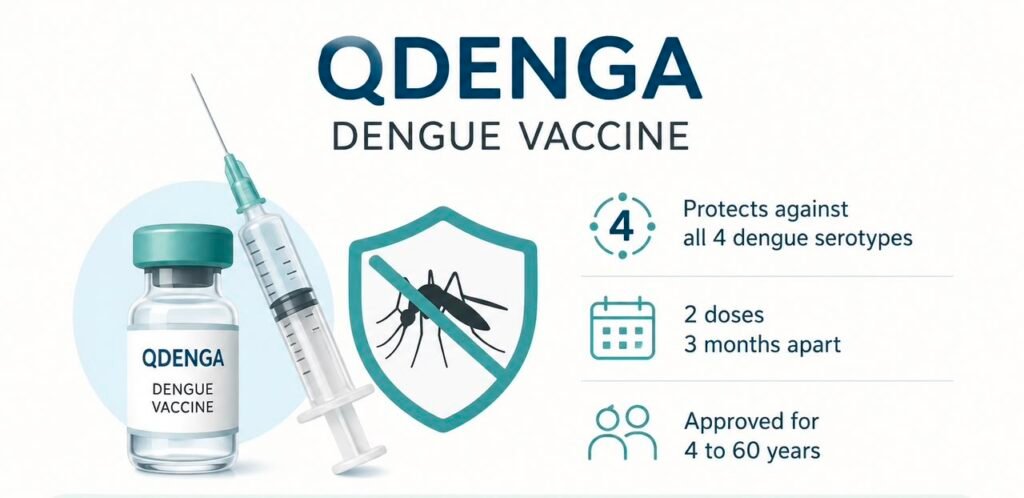
In a landmark development, India has approved QDENGA (TAK-003), making it the country’s first approved dengue vaccine. Developed by Takeda, this live-attenuated tetravalent dengue vaccine has received approval from the Drug Controller General of India (DCGI) for individuals aged 4 to 60 years.
The vaccine is administered as two 0.5 mL subcutaneous doses, given three months apart and is designed to provide protection against all four dengue virus serotypes.
One of QDENGA’s biggest advantages is that pre-vaccination screening is not required. Unlike some dengue vaccines that require prior confirmation of previous infection, QDENGA can be administered regardless of a person’s dengue history. This makes vaccination more practical in dengue-endemic regions where routine antibody testing is often difficult or unavailable.
Strong Scientific Evidence Supports QDENGA
The approval of QDENGA is backed by extensive scientific research. The vaccine has been evaluated in 19 Phase I, II and III clinical trials involving more than 28,000 participants worldwide, including the Indian Phase III DEN-302 trial.
Clinical studies have demonstrated that the vaccine has a favorable safety profile, induces a strong immune response and provides sustained protection against dengue.
QDENGA has also received WHO prequalification and the World Health Organization recommends its use in dengue-endemic areas with high transmission, paving the way for potential inclusion in national immunization programmes.
A Vaccine Is Not a Replacement for Dengue Prevention
Although the approval of India’s first dengue vaccine is a significant achievement, vaccination should complement—not replace—existing dengue prevention and control measures.
Comprehensive dengue control continues to rely on:
* Effective mosquito vector control
* Elimination of mosquito breeding sites
* Early diagnosis and prompt treatment
* Strong disease surveillance
* Active community participation
The Aedes mosquito, which spreads dengue, primarily bites during the daytime, especially in the early morning and late afternoon. People can reduce their risk by:
* Wearing full-sleeved clothing
* Using mosquito repellents
* Installing window and door screens
* Sleeping under mosquito nets where appropriate
* Regularly emptying and cleaning water-holding containers such as coolers, flower pots, buckets, tyres and other artificial water collections that serve as breeding sites.
Looking Ahead
The approval of QDENGA marks a major milestone in India’s fight against dengue. If incorporated into the National Immunization Programme in the future, particularly in high-burden states, it could provide an additional layer of protection against dengue and help reduce severe disease, hospitalizations and deaths.
However, the greatest public health impact will be achieved when vaccination is integrated with effective vector control, strengthened surveillance, early diagnosis, timely treatment and sustained community engagement. Together, these measures offer the strongest strategy for reducing India’s growing dengue burden.






No Comment! Be the first one.