








India Weighs Six-in-One Vaccine as Study Finds Fewer Injections Could Simplify Childhood Immunisation
India could make childhood vaccination simpler by moving towards a six-in-one vaccine, but the price of the new vaccine remains a major hurdle, according to a recent economic study involving...

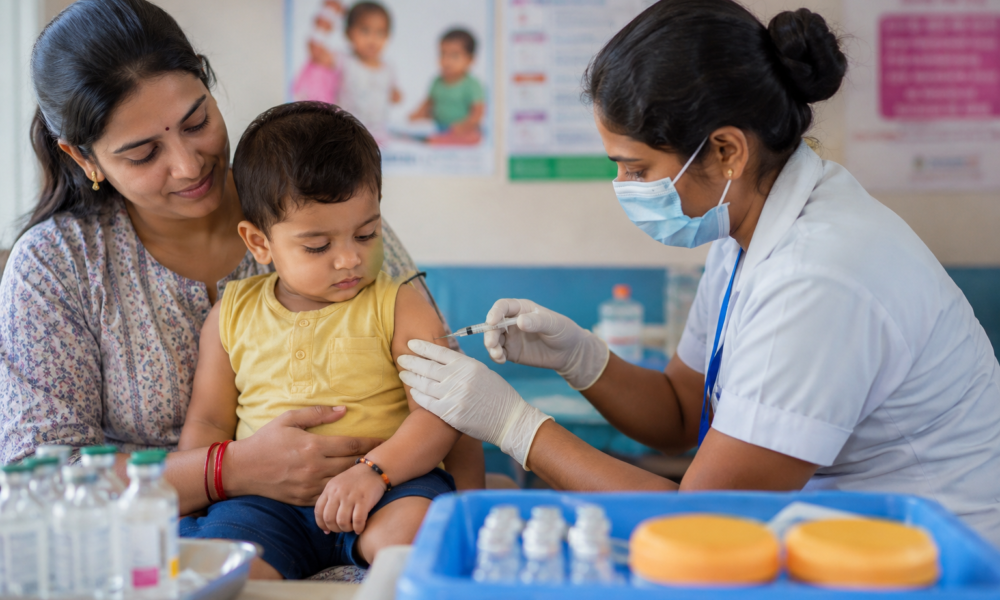
India could make childhood vaccination simpler by moving towards a six-in-one vaccine, but the price of the new vaccine remains a major hurdle, according to a recent economic study involving researchers from India’s Ministry of Health and Family Welfare, the Gates Foundation, the George Institute for Global Health, Gavi and other institutions.
The study, published in June 2026, examined what could happen if India replaced its existing combination of pentavalent vaccine and fractional inactivated polio vaccine with a hexavalent vaccine. The six-in-one vaccine combines protection against the five diseases covered by the pentavalent vaccine with protection against polio.
India runs one of the world’s largest immunisation programmes, reaching around 26 million infants and 29 million pregnant women every year. The national programme protects children against a range of vaccine-preventable diseases, including diphtheria, pertussis, tetanus, polio, measles, rubella, hepatitis B and diseases caused by Haemophilus influenzae type B.
The biggest advantage of a hexavalent vaccine is that it can reduce the number of separate injections needed during vaccination visits. That could make the process easier for parents and children while also reducing the workload for health workers.
The study looked at two possible approaches. In the first, the hexavalent vaccine would replace the existing pentavalent vaccine and fractional IPV. In the second, it would also replace the first DTP booster. Researchers assessed the costs for the government as well as households, including the time spent by parents, health workers and other staff.
The results showed that the switch could generate significant operational savings. Under the first scenario, the researchers estimated savings of about ₹918.7 crore from areas including lower spending on existing vaccines, fewer syringes, reduced cold-chain requirements and less staff and caregiver time.
However, there is a catch. The hexavalent vaccine itself is more expensive, which means the overall programme would still cost more at the current assumed price. The study estimated an additional economic cost of about ₹882.1 crore under the first scenario.
Price, therefore, could decide whether the vaccine becomes economically attractive for a programme operating at India’s enormous scale.
Researchers found that cutting the price of the hexavalent vaccine by 50% could make the first replacement scenario cost-saving. In the second scenario, an even lower price would be needed to offset the additional cost.
The findings do not mean India is immediately adopting the six-in-one vaccine nationwide. Instead, they provide policymakers with information on the costs, savings and procurement prices that would need to be considered before making such a decision.
For families, the potential benefit is straightforward. Fewer injections could mean simpler vaccination visits and less time spent travelling to and waiting at healthcare centres. For the health system, fewer vaccine administrations could also reduce pressure on staff and logistics.
The study points to a wider issue facing India’s healthcare system: improving healthcare is not only about introducing new medical products. Cost, procurement, logistics and ease of delivery can determine whether an innovation works at national scale.








No Comment! Be the first one.